SongPop® - Guess The Song
- 4.1
- Rating
- 1.00M
- Installs
- Free
- Price
 Analysis by App-foxy
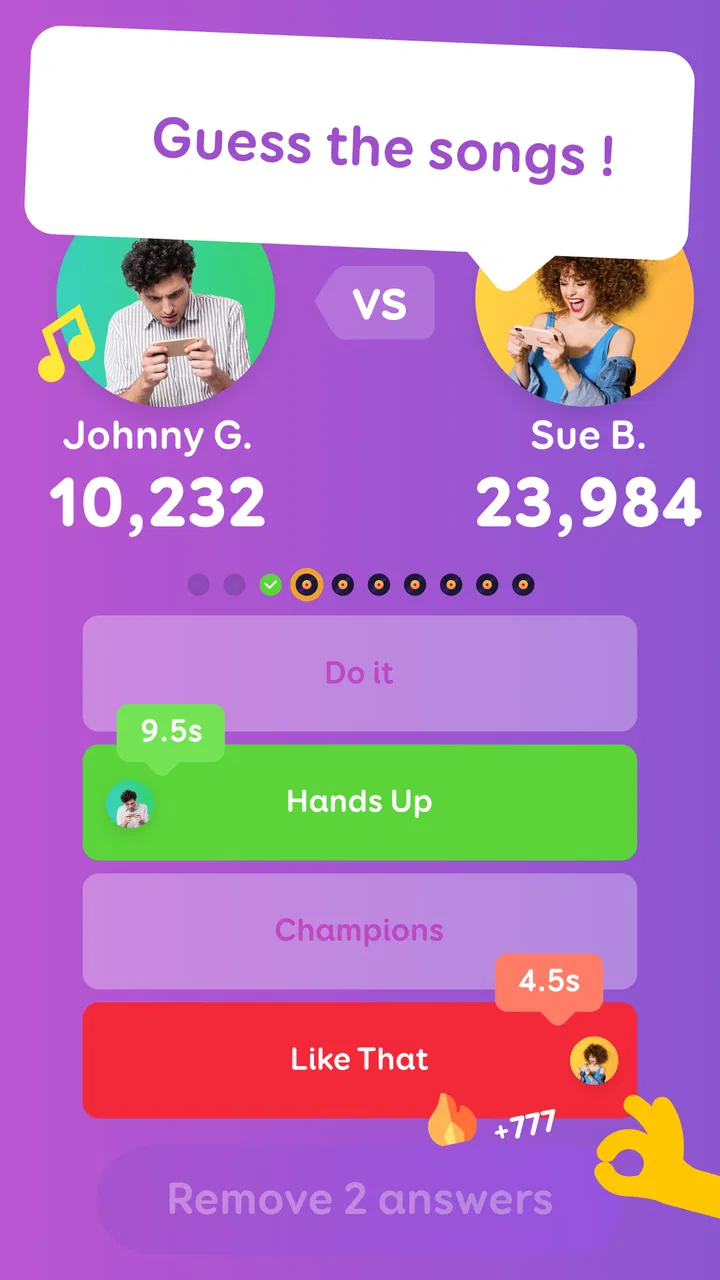
I enjoy trivia games most when they test something I actually use every day, and music is a particularly good fit. I can forget a song title while still recognizing the opening second, the singer’s voice, or a chorus I have heard for years. SongPop® turns that kind of recognition into a quick music quiz built around guessing real songs and artists across different genres. Developed by FreshPlanet, it is a free game for Android and iOS in the trivia category, aimed at anyone who wants a lightweight way to challenge their musical memory.
My first impression is that this is less about proving who has the best general knowledge and more about discovering where personal listening habits help or fail. Someone who knows current pop may struggle with older rock, while a fan of classic hits may be quick with familiar guitar riffs but slow on newer artists. That variety gives each round a personal feel, although it also means the experience depends heavily on whether the available music matches your taste.
How the music quiz feels in everyday play
The basic appeal is easy to understand: listen carefully, identify what you hear, and make a choice before the moment disappears. That sounds simple, but the short decision window changes the way I listen. I am not only asking myself whether I know a song; I am trying to separate a genuine memory from a vague feeling that the track sounds familiar.
You May Also Like

 Blood Strike: 2.5 Anniversary
Blood Strike’s Loadouts Turn Every Drop Into a Tactical Gamble
A close look at Blood Strike’s custom loadouts: how fast access to signature weapons reshapes its battle royale rhythm, rewards preparation, and narrows the gap between fights.

 Pandora - Music & Podcasts
Pandora’s Music Is Easy to Start, but Harder to Recover
Pandora’s strength is its low-effort path from a seed to a station. Its weak spot is how much confidence it asks you to place in connection, setup, and quiet recovery.

 8 Ball Pool
 Is Built on Rivalries, Rematches, and Routine
A close look at the rivalries, rematches, shared routines, and unanswered safety questions that turn a quick pool match into a persistent mobile community.

 Samsung Music
’s Quiet Strength Is Playing What You Already Own
Its reach comes less from spectacle than from dependable access to a personal library. That simplicity is both the app’s strongest retention engine and its ceiling.

 AccuWeather: Weather Radar
AccuWeather Review: A Quick, Clear Forecast for Everyday Decisions
For everyday plans, the best forecast is the one you can understand quickly. AccuWeather makes rain timing, radar, and local conditions easy to act on, with a few trade-offs.

 Hill Climb Racing
Why Hill Climb Racing Still Turns Crashes Into One More Run
A tiny car, a bumpy hill and one more upgrade: Hill Climb Racing keeps resurfacing because its simple chaos makes every near-miss feel personal.
More From Our News Desk



That makes the game a good companion for small gaps in the day. I can imagine playing during a short break, while waiting for a friend, or on a relaxed evening when nobody wants to commit to a long game. It does not demand the same attention as a full strategy title, yet it is more involving than casually scrolling through a playlist because every musical fragment becomes a small test.
The strongest use case is sharing it with people whose music backgrounds are different from mine. A friend may recognize an artist immediately, while I know the song but not the performer. Those moments create natural conversation: we end up discussing where we heard a track, which decade it belongs to, or why one person remembers a chorus that another completely missed. The game works best when the quiz becomes a starting point for that kind of exchange.
I would not choose it as a replacement for a music-streaming service. A streaming app is better when I want control over the exact artist, album, or mood. This game is better when I want surprise and a reason to pay close attention. The distinction matters, because its value comes from the challenge rather than from giving me a carefully selected listening session.
Recognition is not the same as musical knowledge
One useful thing I noticed is how often recognition arrives in stages. I may identify the rhythm first, then the voice, and only afterward remember the title. That creates a practical tactic: instead of forcing an immediate answer, I listen for the most distinctive clue. Is it the vocalist, the production style, an unusual instrument, or a familiar phrase? Training myself to listen that way makes later rounds feel less dependent on lucky guesses.
Another helpful habit is treating wrong answers as information rather than simply failures. If I repeatedly confuse two artists, I can pay attention to the difference in their vocal tone or the period when their songs were popular. This turns casual play into a small memory exercise. It is not formal music education, but it can sharpen recall for people who enjoy learning through repetition.
The opposite is also true: a player with a narrow listening history may feel disadvantaged even when they are good at trivia generally. A person who mainly listens to one language, decade, or genre could encounter many unfamiliar choices. That is not necessarily a flaw in the quiz, but it is an important expectation to set. The challenge measures exposure as much as raw knowledge.
Progress can be motivating, but it can also create pressure
Short music rounds encourage the “one more attempt” feeling. When I miss a song by a single choice, the mistake feels close enough to correct immediately. That is a powerful reason to continue, especially when the next track might cover a style I know well. The format makes progress feel personal because improvement often comes from recognizing patterns in my own weaknesses.
There is a trade-off, though. Fast decisions can make the game feel more stressful than a relaxed quiz with unlimited time. If I am playing after a tiring day, a difficult clip can feel less like entertainment and more like a test I am failing in public. I prefer approaching it with a learning mindset: accept that unfamiliar music will appear, and use each round to notice what I do not know.
For younger players, the content rating is Everyone, which makes the game broadly approachable for families. Even so, I would still treat it as a shared activity rather than assuming every child will enjoy it equally. A child who loves discovering songs may stay engaged, while someone without much exposure to varied music may need encouragement or an adult playing alongside them.
It is also worth remembering that a free download does not automatically mean every part of the experience is free from spending prompts. The game includes in-app purchases ranging from $0.99 to $99.99 per item. I see that as a reason to decide on a personal rule before playing: either enjoy the free experience without buying anything, or set a firm limit rather than making a quick purchase after a frustrating miss.
What spending does and does not tell me
The purchase range is clear, but the practical effect of spending is not something I would assume without seeing the exact offer presented in the app. I would not promise that buying an item guarantees better songs, faster progress, or a competitive advantage. A careful player should read each purchase screen and ask what is actually being offered before confirming payment.
This is especially important in a music game because frustration can arrive at a very specific moment: I know the melody, hesitate over the artist, and lose the round. That is precisely when an optional purchase can feel tempting. My advice is simple: do not buy merely to erase the feeling of being wrong. If the game stops being enjoyable without spending, it may be better to close it and return later.
For parents, the combination of an Everyone rating and optional purchases deserves a quick conversation about device payment settings. The age rating describes the suitability of the content, not a promise that a child will understand the value of every purchase prompt. I would let a child play, but I would make sure payment approval is handled by an adult.
For adults, the game is easier to recommend as a free trial of the experience. Play first, see whether the music selection suits you, and only then decide whether any optional item has real value for your habits. Since the purchase amounts vary widely, treating every offer as automatically worthwhile would be a mistake.
Fairness depends on taste as much as speed
The most interesting fairness question is not simply whether everyone receives the same kind of challenge. It is whether the challenge feels meaningful for the people playing. Two players can have identical reaction speed and completely different results because one has spent years listening to a particular genre. In that sense, the game rewards cultural exposure, memory, and quick recognition at the same time.
That can be fun in a mixed group because each person brings a different advantage. It can also feel uneven if one player’s favorite music appears frequently while another player’s knowledge rarely matters. I would avoid judging skill from a single session. A better comparison comes from several rounds, where luck and personal taste have less influence.
A practical way to make group play fairer is to agree on the tone before starting. If everyone wants a serious competition, keep the scores and celebrate close calls. If the group includes beginners, treat the rounds as a shared guessing game rather than a test of expertise. The latter approach is more welcoming and reduces the pressure that can make unfamiliar music feel embarrassing.
I also like the possibility of using the game as a conversation tool between generations. An older player may recognize classic recordings instantly, while a younger player may know current performers better. Neither person is automatically the better trivia player; they simply have different musical maps. That makes the game more interesting than a fixed quiz where the same person always dominates through general knowledge.
Where it compares well with other trivia choices
Compared with broad trivia games, this one has a narrower subject but a more immediate sensory hook. General quizzes ask me to retrieve facts from memory, while a music quiz lets me react to sound. That makes the experience more emotional and sometimes more forgiving: a melody can trigger a memory even when I cannot explain why I know it.
Compared with a standard music-identification quiz, the appeal here is the wider social potential. It is not only about naming a track in isolation; it can become a contest between different listening histories. Still, someone who wants detailed information about albums, lyrics, instruments, or music theory may prefer a dedicated educational tool. This game is focused on recognition and competition, not on teaching the structure of music.
Compared with simply asking friends to identify songs from a playlist, the app provides a more organized activity and removes the need for one person to act as quiz host. The downside is reduced control. When I create my own playlist, I can choose the exact difficulty and audience. Here, the surprise is part of the fun, but it can also produce rounds that feel poorly matched to a particular player.
Device expectations and the practical details
The game is free to install and has passed one million installs, so it is clearly not an obscure experiment with no established audience. Its average rating is 4.2 from roughly 24,000 ratings, alongside about 1,400 written reviews. I read those figures as evidence of broad interest rather than a guarantee that every player will enjoy the same music mix.
It was released on March 18, 2021, and the current version is 003.030.019. The Android requirement is version 7.0 or later, which makes it accessible on many older devices. Even with that compatibility, I would still keep the operating system updated when possible, particularly for a game that depends on audio and quick interaction.
The developer is FreshPlanet, and the product is presented as SongPop® - Guess The Song. Those details are useful when searching for the correct app, especially because music quiz names can sound similar. I would check the developer name and the spelling before installing so I do not accidentally choose an unrelated title.
One detail I would consider before downloading is my own tolerance for repeated listening. Music recognition games naturally revisit familiar patterns: opening notes, recognizable voices, and songs that are easy to identify. That repetition can be satisfying when I am improving, but it may become less appealing if I want constant novelty or a calm listening experience without performance pressure.
Who should play, and who should skip it
I recommend it to people who can name a song from a few seconds, enjoy friendly rivalry, or want a quick activity that works around everyday interruptions. It is particularly suitable for groups with varied musical tastes because the uneven knowledge can create funny surprises instead of making every question predictable.
I would also suggest it to someone trying to broaden their listening habits. Even when I do not know an answer, the mistake points toward an artist or style I might want to explore later. The game cannot replace deliberate discovery, but it can reveal gaps in my awareness and give me a reason to investigate them.
I would skip it if I dislike timed guessing, feel uncomfortable with competitive scoring, or want complete control over the music. It is also a weak fit for someone seeking deep explanations of music history or theory. In those cases, a curated educational resource or a personal playlist would serve the purpose better.
People who are very sensitive to optional purchase prompts should approach it cautiously. The free price is attractive, but the presence of items from $0.99 to $99.99 means I would not hand over a device with unrestricted payment access to a child. I would also avoid spending until I know that the core quiz itself holds my attention.
My trust verdict after weighing the trade-offs
My overall view is positive, with one important qualification: the game is strongest when I treat it as a casual test of musical memory rather than a definitive measure of knowledge. The format is easy to understand, the subject is naturally engaging, and the short sessions fit real life. Its main weaknesses are equally clear: personal taste can make the challenge uneven, quick decisions can create pressure, and optional purchases require self-control.
I appreciate that the game can serve several purposes without pretending to be something more serious. It can fill a spare minute, start a conversation, expose me to unfamiliar artists, or create a playful contest between friends. Those uses are more convincing to me than any promise of becoming an expert, because they match what the experience actually does well.
My practical recommendation is to install it only if the idea of identifying songs sounds enjoyable on its own. Play several sessions before considering a purchase, keep payment controls in mind, and judge the experience across different genres rather than one unlucky round. If the music feels familiar enough to be rewarding but varied enough to stay interesting, it is an easy game to keep around.
SongPop® is therefore a good choice for music lovers who want recognition, rivalry, and quick entertainment in one place. I would recommend it to a friend who enjoys saying “I know this song” and proving it under pressure. I would not recommend it to someone looking for a fully controlled playlist, a theory lesson, or a competition where every player starts with the same knowledge. Used with those limits in mind, it offers a lively and approachable trivia experience without requiring a large time commitment.
FAQs for SongPop® - Guess The Song
01What is SongPop and how does it work?
SongPop is a popular music trivia game that challenges players to guess songs from a variety of genres and eras. Players listen to short clips of songs and compete against friends or other players to identify the correct song title or artist as quickly as possible. The game features a vast music library and multiplayer options.
02Is SongPop available for both Android and iOS devices?
Yes, SongPop is available for download on both Android and iOS platforms. Users can find the game on the Google Play Store for Android devices and the Apple App Store for iOS devices. Both versions offer similar features, ensuring a consistent and enjoyable gaming experience across platforms.
03Are there any in-app purchases in SongPop?
SongPop does offer in-app purchases. While the game is free to download and play, players can purchase additional features like premium playlists, power-ups, and ad-free experience. These purchases can enhance gameplay but are not necessary to enjoy the core features of the game.
04Can I play SongPop with friends, or is it only single-player?
SongPop is designed to be a social game, allowing players to challenge their friends or other players worldwide. You can connect with friends via social media or invite them through in-game features. The multiplayer aspect adds a competitive edge and makes the game more engaging and fun.
05Is there an offline mode available in SongPop?
SongPop primarily requires an internet connection to function, as it relies on streaming music clips and connecting players for multiplayer matches. However, some limited features may be available offline, but for the full experience, including challenges and updated playlists, an internet connection is necessary.
Pros
- Extensive music library with diverse genres.
- Real-time multiplayer enhances competition.
- Frequent updates with fresh content.
- User-friendly interface and design.
- Educational for music lovers.
Cons
- Requires internet for full functionality.
- In-app purchases can be pricey.
- Ads can disrupt gameplay experience.
- Some features locked behind paywall.
- Occasional lag in live matches.

SongPop® - Guess The Song
Gallery